Aaron Nichols – Portfolio of Works
For Princeton application – Notes and recordings presented in order – scores linked on the title of each piece.
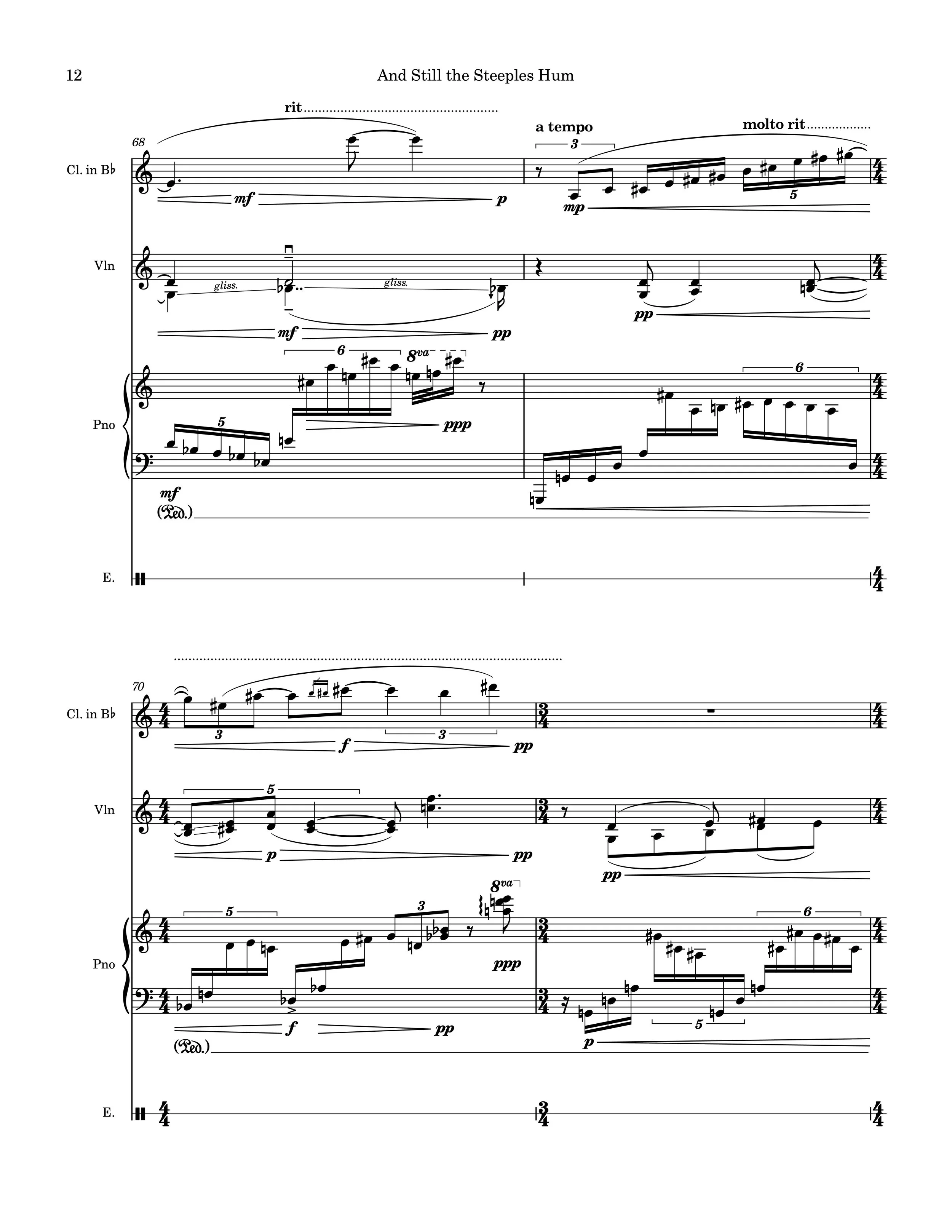
For the last nine months, I have had a certain fixation with A. E. Housman’s “Bredon Hill,” as well as Ralph Vaughan Williams’s setting of it. The poem draws an analogy between church bells ringing on Bredon Hill and the narrator’s loss of a lover. The connection between the bells and the narrator’s memories of this lover is utterly inextricable: their hoped wedding is symbolized, as well as the lover’s sudden death, and funeral. The bells are at once a source of fond memory, and of bitter torment.
In “And Still the Steeples Hum,” I write somewhat in response to Houseman and Vaughan Williams. Similarly to Vaughan Williams, this piece is cyclical: similarly to Vaughan Williams, this piece derives much of its textural language from an onomatopoeic treatment of the bells. My primary clarinet theme, furthermore, pays direct homage to the soloist’s main melody in Vaughan Williams’s setting: however it is presented with greater hesitation, and with the clangor of the bells in the background. If Vaughan Williams’s “Bredon Hill” is a straightforward emotional release, “And Still the Steeples Hum” is a panic attack.
“And Still the Steeples Hum” was written for Unheard-Of Ensemble, who premiered and recorded the work on November 14th, 2025 in Oberlin, Ohio.
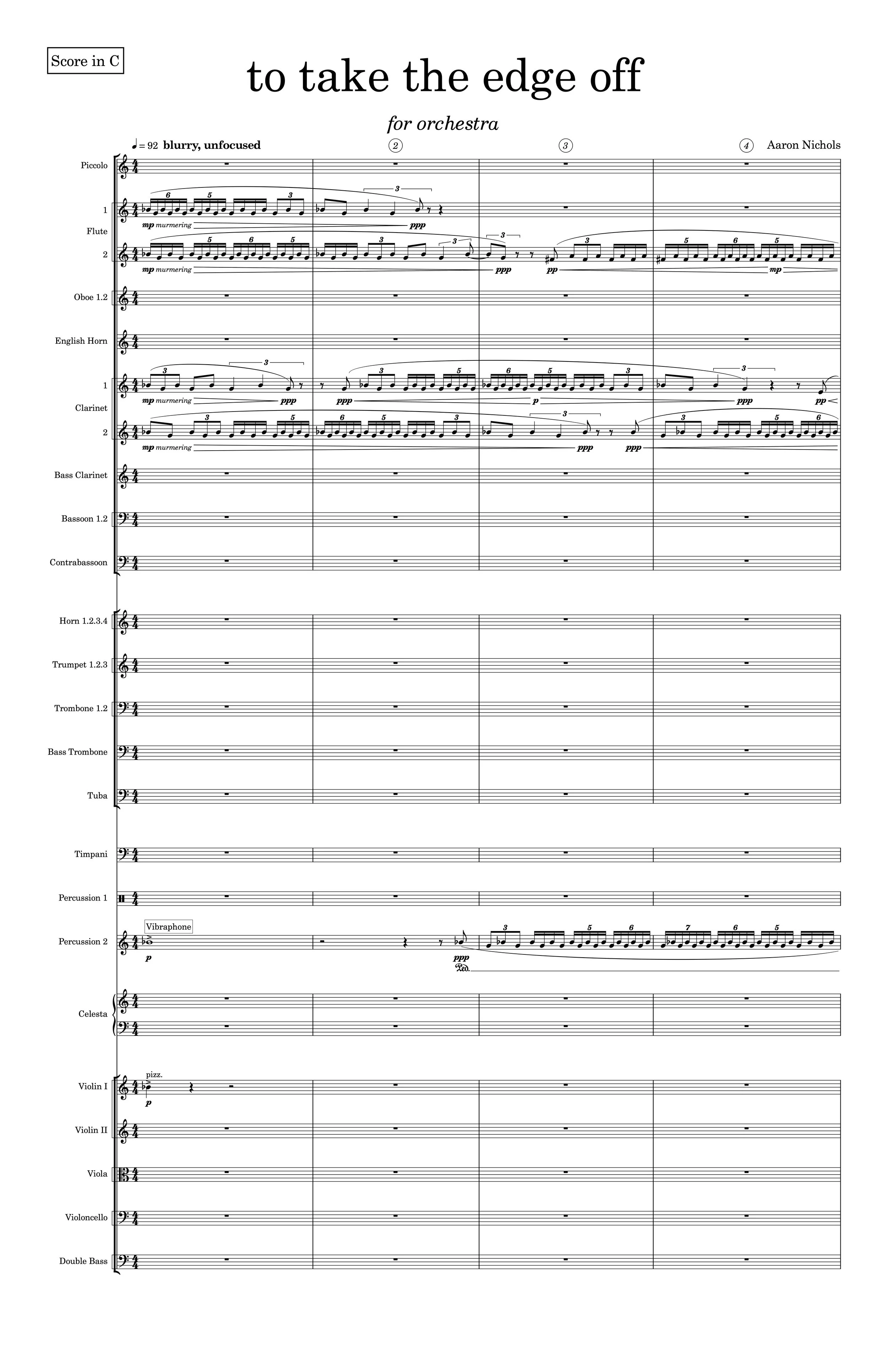
"To Take the Edge Off" attempts to convey a feeling of transience in harmony, texture, and form. The harmonic language of the piece favors octatonic and hexatonic collections, whose symmetrical structures avoid harmonic "edges," and support the shimmering, mercurial textures that are present throughout. The idiom to take the edge off describes the temporary alleviation of something uncomfortable, be it hunger, cold, or physical or emotional pain. As I wrote the piece, I thought of this concept, and of the futility of trying to find short answers to complex problems: an easy fix will usually only serve to obscure the truth, and not to grapple with it.
I view the piece as a series of episodes, or variations on a couple essential musical ingredients: a twelve-tone row, a minor third embedded in that twelve-tone row, and the uncomfortable coexistence of octatonicism, hexatonicism, and the implications of triadic harmony. As it wanders through this hazy harmonic landscape, the music struggles to find a sense of where it is, or where it truly wants to be.
To Take the Edge Off was read by the Oberlin Orchestra on November 1st, 2024.
Mesovortex is inspired by, and structured loosely around time lapse footage of tornadogenesis. When sped up, one can clearly see the ordinary cloud formations caught in an inexorable, yet invisible pull towards themselves–one that is less obvious in real time. This process feels analogous to the unraveling of human emotions: normal events, aligned properly, can grind against one-another, creating anger or fear out of virtually nothing. The piece takes advantage of the saxophone quartet’s capacity to melt into itself–to form more of a mercurial, polyphonic plasma than four distinct voices.
The primary textural goal, throughout this piece, is to create a frenetic, micropolyphonic soup. With a few exceptions, (soli, sudden changes, lines should feel as though they emerge from the overarching texture.
Mesovortex was written for PRISM quartet, in a joint commission by the quartet and the Walden School (Dublin NH.) It was premiered on November 17th, 2024 in Philadelphia, and performed again and recorded in New York the following day.

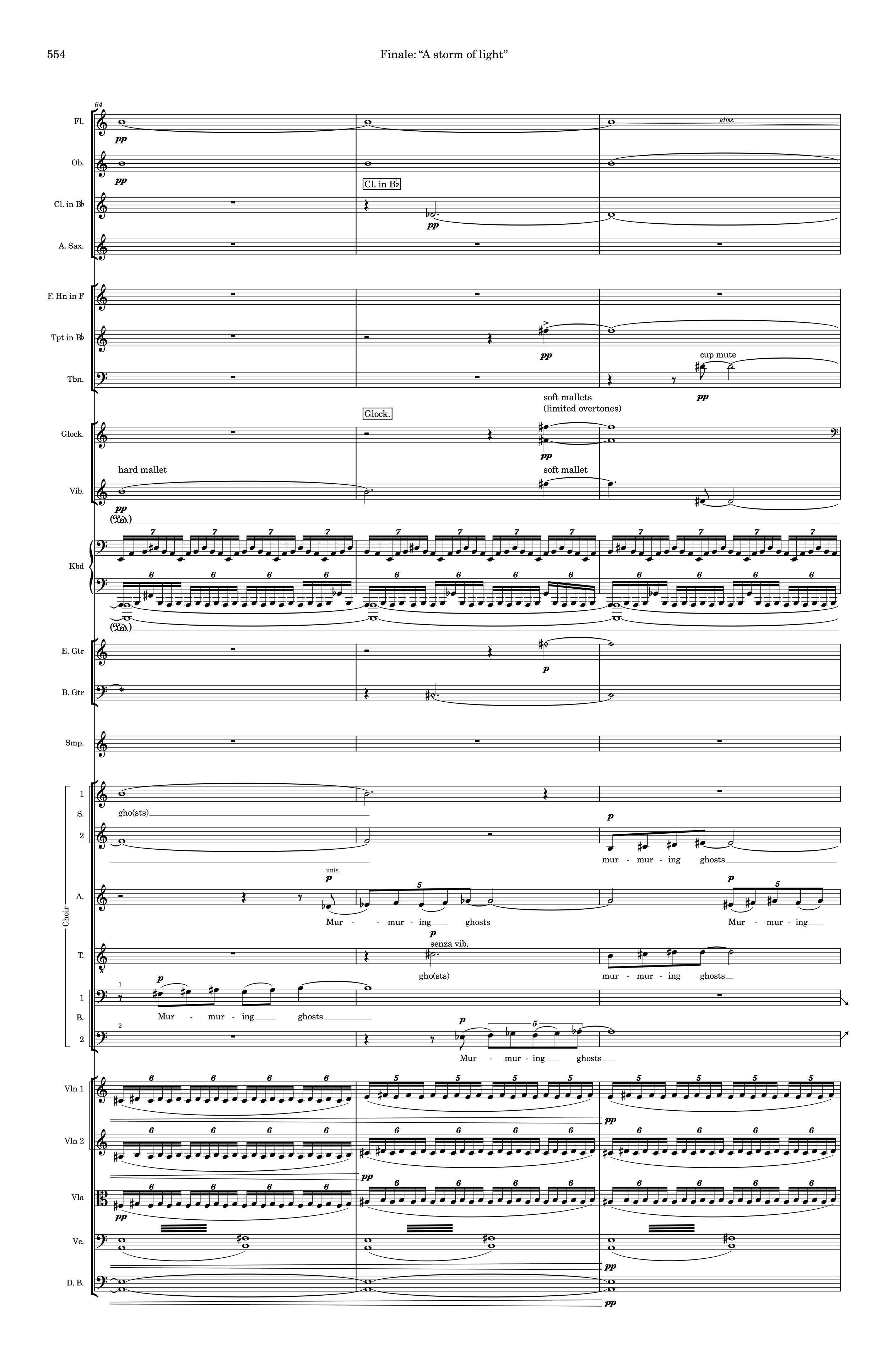
Text adapted from the Bradbury by Katharina Mueller and Aaron Nichols
Notes from the score:
This opera attempts to capture both the specific 1950s stylizations of the time in which Fahrenheit 451 is written, and the broader, more universal idea of total technological control and dependence. It does not necessarily exist in the current future, or modern day. The fremen are macho, chummy-yet-bullying types when off-duty, and soldiers
when on-duty. The civilians are brain-dead, happy, blood-thirsty, and entirely disconnected. The advertisors and TV characters are slick, charming, and ultimately predatory. The TV reality should feel almost like a part of the real reality – incipid, stylized, entirely without genuine life to it, yet with a faux-inviting quality. The opera is designed, in part, to feel as though it is being experienced as something of a traumatic series of episodes: the scenes are mostly linear, but should feel like they follow each other too quickly, and rarely with enough time to process them.
Included excerpts: scenes four and five of act three
Performed by:
Clarisse: Molly Chun
The Now Chorale (student org) and the “Fahrensemble” (student pick-up orchestra), conducted by Matthew Thomas Brown; Oberlin Conservatory, C25, December 12th, 2025
Scene IV:
Guy Montag, after killing his captain, runs through the streets towards the river at the edge of the city, as television broadcasts track and update the search for his whereabouts. As he runs, he sees the news snippets through the windows of homes, as the chase that could take his life is turned into a grotesque sport. These broadcasts are interrupted by garish advertisements, which in turn are interrupted by Clarisse, appearing as a memory, musing on the incessant commercialism, and breakneck pace of life in the modern world. Montag makes it to the river by the skin of his teeth, as the announcer encourages everyone in the city to look out their windows simultaneously – which would all but ensure Montag’s capture.
CLARISSE.
Did you know that once billboards were only twenty feet long, instead of two-hundred? But cars started rushing by so quickly they had to stretch the advertising out so it would last.
Sometimes I think drivers don't know what grass is, or flowers, because they never see them slowly. If you showed a driver a green blur, Oh yes! he'd say, that's grass! A pink blur? That's a rose-garden! White blurs are houses. Brown blurs are cows.
My uncle drove slowly on a highway once. He drove forty miles an hour and they jailed him for two days. Isn't that funny, and sad, too?
Scene V:
Choral finale: Montag has waded into the river, and follows it out of the city – his exact fate is unknown.
CHOIR.
A storm of light falls upon the river
like the sun breaking through the clouds
and plunging into the darkness.
You dive into the darkness;
the river pulls you on its way;
the lights switch back to the land
and follow another trail.
You follow the stars,
the great processions of wheeling fire.
The black land slides by:
you leave behind a city.
You leave behind a stage
And many actors, murmuring ghosts:
You leave behind an unreality.
You move into a reality, unreal as it is new:
a great juggernaut of stars forming in the sky,
threatening to roll over and crush you.
You leave behind a city.
You leave behind a seance.